Norsk versjon — Bokmål
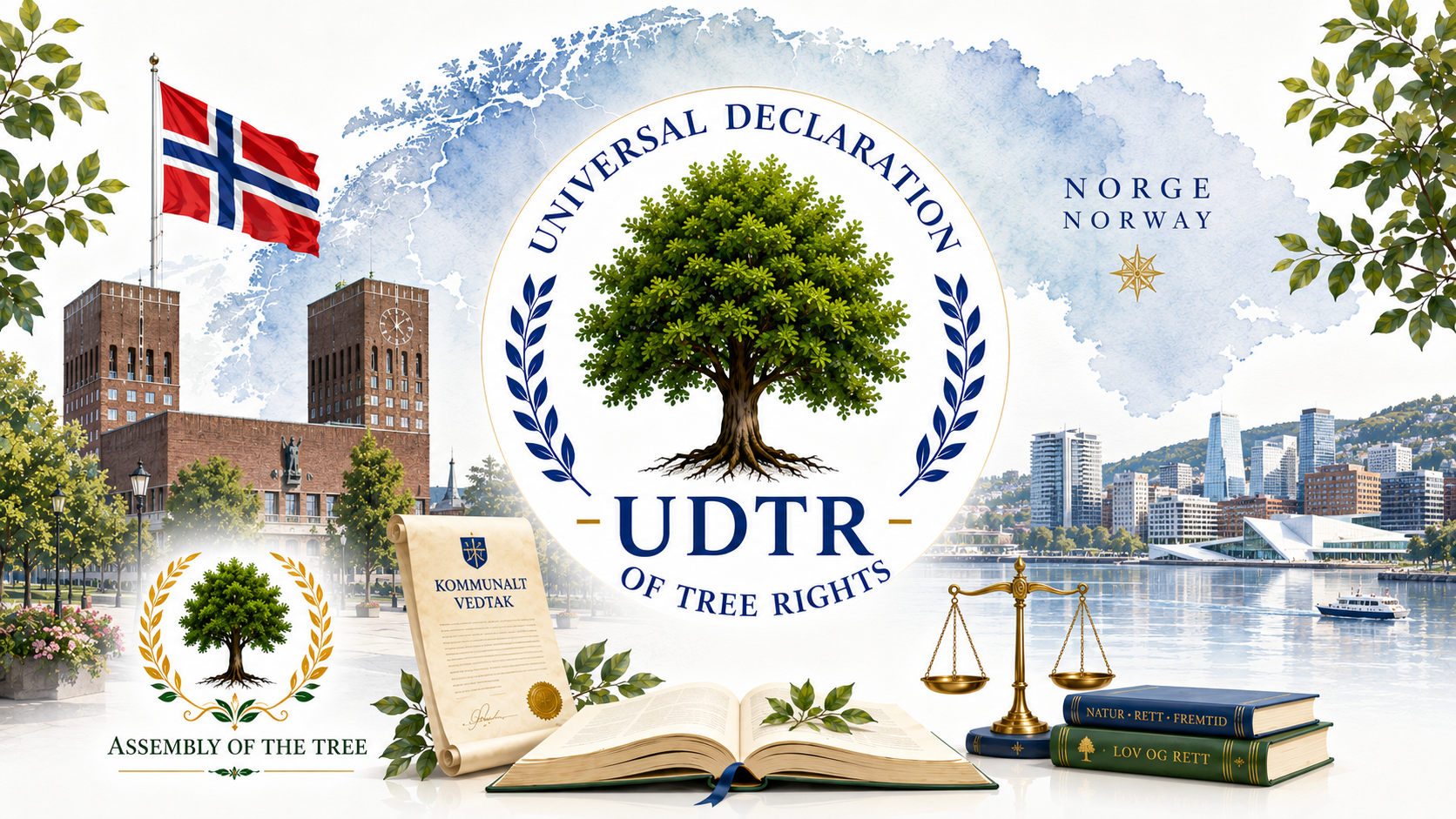
Den 9. juni 2026 vedtok kommunestyret i Terrasse-Vaudreuil i Québec resolusjon nr. 2026-06-111 om Universal Declaration of Tree Rights.
Beslutningen viste at en lokal myndighet kan anerkjenne prinsippene i Erklæringen og begynne å organisere en gradvis lokal gjennomføring innenfor sitt eget rettssystem, uten å vente på en generell reform av nasjonal lovgivning.
Spørsmålet har allerede nådd den norske offentligheten.
Den 2. juli 2026 publiserte det norske magasinet Harvest en artikkel av Knut Laasbye med tittelen «Et tre har fått rettigheter. Nå begynner det vanskelige.» Teksten tar utgangspunkt i beslutningen i Terrasse-Vaudreuil og bringer spørsmålet om trær, rettigheter og menneskelig ansvar direkte inn i en norsk offentlig sammenheng.
Debatten har nådd Norge
Harvest — 2. juli 2026
Les « Et tre har fått rettigheter. Nå begynner det vanskelige. »
Harvest-artikkelen er en journalistisk og essayistisk analyse. Den er ikke en norsk rettskilde og utgjør ikke en offisiell institusjonell fortolkning av Universal Declaration of Tree Rights. Tittelen er magasinets redaksjonelle formulering og må holdes atskilt fra den presise juridiske virkningen av kommunestyrets vedtak.
Når debatten allerede er til stede i Norge, oppstår derfor et konkret spørsmål:
Kan en norsk kommune eller fylkeskommune selv vedta Universal Declaration of Tree Rights og de femten forpliktelsene for lokale og regionale myndigheter – og deretter gjennomføre dem gradvis innenfor norsk rett?
På grunnlag av Grunnloven, kommuneloven og de sentrale norske reglene om planlegging, naturmangfold, skogbruk, offentlige anskaffelser, lokaldemokrati og konsultasjoner, fremstår en slik institusjonell tilslutning som rettslig mulig, forutsatt at beslutningen treffes av kompetent organ og at senere bindende tiltak gjennomføres med de hjemlene, virkemidlene og prosedyrene norsk rett krever.
Universal Declaration of Tree Rights er grunnteksten i en institusjonell prosess som bæres og utvikles av La Compagnie des Papillons Bleus, som ivaretar rammeverkets sammenheng, dokumentasjon, institusjonelle oppfølging og internasjonale register.
En norsk kommune eller fylkeskommune som ønsker at tilslutningen skal inngå som en offisiell tilslutning innenfor dette institusjonelle rammeverket, skal innlede dialog direkte med La Compagnie des Papillons Bleus før den endelige politiske behandlingen og følge den etablerte prosedyren.
1. Erklæringens rettslige og institusjonelle karakter
Universal Declaration of Tree Rights er en grunnleggende tekst som formulerer prinsipper om anerkjennelse, respekt, beskyttelse og menneskelig ansvar overfor Treet. Den inngår i et etisk, vitenskapelig, normativt, juridisk, demokratisk, kulturelt, pedagogisk og institusjonelt rammeverk.
Erklæringen er ikke en juridisk person, en offentlig myndighet, en sertifiseringsmyndighet eller en internasjonal organisasjon. Når det vises til institusjonell oppfølging, dokumentasjon, formalisering eller registrering, er den institusjonelle aktøren La Compagnie des Papillons Bleus.
En norsk kommunal eller fylkeskommunal tilslutning innebærer ikke:
- signering eller ratifikasjon av en internasjonal traktat;
- at Norge, kommunen eller fylkeskommunen blir part i den foreslåtte International Convention on Tree Rights;
- at Erklæringen automatisk blir norsk lov eller forskrift;
- at trær automatisk får generell juridisk personlighet eller generell prosessuell partsevne;
- automatisk endring av offentlig eller privat eiendomsrett;
- overføring av norsk offentlig myndighet til La Compagnie des Papillons Bleus;
- umiddelbar opprettelse av nye bindende plikter eller sanksjoner overfor private.
Erklæringen etablerer et felles prinsippgrunnlag. De konkrete rettsvirkningene av lokale tiltak må deretter følge av de beslutningene, planene, kontraktene, forskriftene eller andre instrumentene kommunen har adgang til å bruke etter norsk rett.
2. Norsk forvaltningsstruktur: stat, fylkeskommune og kommune
Norsk offentlig forvaltning er organisert på flere nivåer. Staten vedtar de nasjonale rettslige rammene. Kommunene og fylkeskommunene er egne rettssubjekter med folkevalgt ledelse og utøver oppgaver og myndighet som følger av kommuneloven og sektorlovgivningen.
Kommuneloven § 2-1 fastslår at hver kommune og fylkeskommune er et eget rettssubjekt og kan ta avgjørelser på eget initiativ og ansvar. Selvstyret utøves innenfor nasjonale rammer, og begrensninger i selvstyret må ha hjemmel i lov.
En kommune kan derfor ikke overta myndighet som Stortinget har lagt til staten, fylkeskommunen eller et annet organ. Men fraværet av en særskilt lovbestemmelse som uttrykkelig nevner Universal Declaration of Tree Rights betyr heller ikke at kommunen er avskåret fra å vedta en institusjonell prinsipp- og styringsramme for sin egen virksomhet.
3. Lokalt selvstyre og negativt avgrenset kompetanse
Grunnloven § 49 fastslår at innbyggerne har rett til å styre lokale anliggender gjennom lokale folkevalgte organer, og at nærmere regler om det lokale folkevalgte nivået fastsettes ved lov.
Kommunelovens forarbeider beskriver kommunenes kompetanse som negativt avgrenset. Det innebærer at kommunen på eget initiativ og ansvar kan påta seg oppgaver og treffe beslutninger ut fra lokale behov og ønsker, så lenge lov eller ulovfestede rettsregler ikke er til hinder, og oppgaven ikke er eksklusivt lagt til andre.
Les Prop. 46 L (2017–2018) om kommunalt selvstyre og negativt avgrenset kompetanse
4. Kommunestyret, fylkestinget, ordføreren og administrasjonen
Kommuneloven § 5-3 fastslår at kommunestyret er kommunens øverste organ og fylkestinget fylkeskommunens øverste organ. De treffer vedtak på vegne av henholdsvis kommunen og fylkeskommunen dersom ikke annet følger av lov.
En institusjonell tilslutning til Erklæringen og de femten forpliktelsene er etter sin karakter en prinsipiell beslutning. Kommunestyret eller fylkestinget er derfor den rettslig og demokratisk sikreste arenaen for selve vedtaket.
Ordføreren kan spille en sentral politisk og representativ rolle og kan signere dokumenter når dette følger av lov, reglement eller særskilt fullmakt. Ordføreren erstatter imidlertid ikke kommunestyrets beslutning i en slik prinsipiell sak.
Etter kommuneloven § 13-1 skal kommunedirektøren påse at saker som legges frem for folkevalgte organer er forsvarlig utredet. Utredningen skal gi et faktisk og rettslig grunnlag for å treffe vedtak.
Et norsk saksfremlegg bør derfor tydelig skille mellom selve tilslutningen, kommunens eksisterende juridiske kompetanser, interne tiltak, budsjettmessige konsekvenser og eventuelle senere tiltak som krever plan, forskrift, tillatelse eller særskilt rettsgrunnlag.
5. Grunnloven §§ 112 og 113: miljøvern og legalitetsprinsipp
Grunnloven § 112 anerkjenner retten til et miljø som sikrer helsen og til en natur der produksjonsevne og mangfold bevares. Naturressursene skal disponeres ut fra en langsiktig og allsidig betraktning som også ivaretar retten for etterslekten.
Dette gir et tydelig konstitusjonelt bakteppe for arbeid med langsiktig naturforvaltning, biologisk mangfold, kunnskap og ansvar overfor fremtidige generasjoner.
Samtidig fastslår Grunnloven § 113 at myndighetenes inngrep overfor den enkelte må ha grunnlag i lov.
6. Tre rettslige nivåer som må holdes atskilt
Nivå 1 — Institusjonelt prinsippvedtak
Kommunestyret eller fylkestinget vedtar Erklæringen og de femten forpliktelsene og fastsetter en overordnet retning for den gradvise gjennomføringen. Dette skaper ikke automatisk nye plikter for tredjepersoner.
Nivå 2 — Tiltak innenfor egen virksomhet
Kommunen kan arbeide med egen eiendom, egne parker, skoler, veier, byggeprosjekter, administrative rutiner, budsjetter, kontrakter, kunnskapsgrunnlag, indikatorer og frivillige tiltak innenfor gjeldende rett.
Nivå 3 — Bindende tiltak overfor tredjepersoner
Forbud, pålegg, bindende planbestemmelser, sanksjoner, avgifter, vilkår eller andre inngrep overfor private krever særskilt hjemmel, kompetent organ og korrekt saksbehandling.
Erklæringen gir dermed retning. Norsk rett bestemmer hvilke virkemidler som kan brukes for å gjøre denne retningen operativ.
7. Hva et norsk vedtak kan inneholde
Den naturlige norske formen er et vedtak av kommunestyret, eller et vedtak av fylkestinget dersom en fylkeskommune slutter seg til rammeverket.
Vedtaket kan blant annet:
- vedta samlet Universal Declaration of Tree Rights og alle de femten forpliktelsene for lokale og regionale myndigheter;
- identifisere nøyaktig hvilke offisielle dokumentversjoner som vedtas;
- legge dokumentene ved saken når kommunens prosedyrer tillater dette;
- knytte tilslutningen til kommunens territorium, natur, trebestand, klimatilpasning, planlegging og egen virksomhet;
- be administrasjonen kartlegge hvilke forpliktelser som allerede helt eller delvis er ivaretatt;
- be om en gradvis implementeringsplan med ansvar, tidsplan og indikatorer;
- starte en kartlegging av trebestanden;
- vurdere en Assembly of the Tree og en Defender of the Tree innenfor norsk organisasjonsrett;
- gjennomgå anskaffelser og tekniske krav i bygge- og anleggsarbeider;
- gi kompetent representant mandat til å fullføre den institusjonelle formaliseringen.
Full tilslutning innebærer ikke at samtlige tiltak må være gjennomført på vedtaksdagen. Det er tekstene som vedtas samlet; den praktiske gjennomføringen er progressiv.
8. Plan- og bygningsloven: et sentralt kommunalt virkemiddel
Plan- og bygningsloven gir kommunene en sentral rolle i arealplanleggingen. Kommunestyret vedtar kommuneplanen, og kommunen har omfattende oppgaver knyttet til arealdisponering, grønnstruktur, samfunnsutvikling og reguleringsplanlegging.
Kommunal- og distriktsdepartementets veiledning presiserer at viktige enkeltelementer som trær, vegetasjon og terrengformer kan beskyttes gjennom reguleringsbestemmelser med hjemmel i plan- og bygningsloven § 12-7 nr. 1 og 6.
9. Naturmangfoldloven: kunnskap, føre-var og samlet belastning
Naturmangfoldloven har som formål at naturen med dens biologiske, landskapsmessige og geologiske mangfold og økologiske prosesser tas vare på gjennom bærekraftig bruk og vern.
Etter § 7 skal prinsippene i §§ 8 til 12 legges til grunn som retningslinjer ved utøving av offentlig myndighet og ved forvaltning av fast eiendom.
- kunnskapsgrunnlaget;
- føre-var-prinsippet;
- økosystemtilnærming og samlet belastning;
- kostnadene ved miljøforringelse;
- miljøforsvarlige teknikker, driftsmetoder og lokalisering.
Dette gir klare berøringspunkter med forpliktelsene om kunnskap om trærne, prosjektvurdering, bevaring av deres vitale miljø og økosystembasert forvaltning.
10. Skogbrukslova: Erklæringen innebærer ikke et generelt forbud mot skogbruk
En norsk analyse kan ikke begrense seg til gatetrær og parker. Norge har store skogarealer og en aktiv skogbrukssektor.
Skogbrukslova regulerer skogbruk og legger ansvar på skogeieren for at tiltak gjennomføres i samsvar med lov og forskrift. Etter § 4 skal skogeieren ha oversikt over miljøverdiene i egen skog og ta hensyn til dem ved gjennomføring av tiltak.
Loven inneholder samtidig en viktig kompetanseregel: Statsforvalteren er skogbruksmyndighet for skog som kommunen eller fylkeskommunen selv eier.
11. Kommunen kan begynne med sitt eget tre- og skogareal
Kommunens rolle som eier og forvalter gir et særlig konkret handlingsrom. Dette gjelder blant annet trær på kommunale parker og grøntområder, gater og plasser, skoler og barnehager, gravplasser, offentlige anlegg, kommunale boliger og institusjoner samt skog, utmark og naturarealer som kommunen eier.
Innenfor gjeldende rett kan kommunen blant annet:
- kartlegge og registrere trær;
- følge alder, art, tilstand og økologisk verdi;
- fastsette interne faglige prinsipper for inngrep og felling;
- beskytte rotsoner og jord under anleggsarbeid;
- prioritere bevaring av etablerte og gamle trær;
- forbedre vekstforhold for nye trær;
- dokumentere faglige begrunnelser for felling;
- måle utviklingen i kronedekke og moden trebestand over tid.
12. Trær, klima, vann, jord og offentlige rom
En moden trepolitikk kan ikke reduseres til antall nyplantede trær. Et tre er avhengig av jord, vann, rotvolum, plass, mikroorganismer, lys og økologiske forbindelser, og dets funksjoner utvikles over tid.
Kommunen kan innenfor eksisterende oppgaver koble trepolitikken til klimatilpasning, overvann, infiltrasjon, jordkvalitet, biologisk mangfold, grønnstruktur, økologiske forbindelser, skygge i offentlige rom og langsiktig forvaltning av store og modne trær.
Dette gir særlig substans til forpliktelsen om å bevare the Vital Environment of Trees: Treet kan ikke forvaltes som om stammen alene var det levende systemet.
13. Offentlige anskaffelser som konkret gjennomføringsverktøy
Offentlige anskaffelser er et særlig konkret norsk virkemiddel. Ved lov 6. mars 2026 nr. 8 ble reglene om samfunnshensyn samlet og tydeliggjort i anskaffelsesloven. De fleste endringene trådte i kraft 1. juli 2026. Hovedreglene om klima- og miljøhensyn følger nå blant annet av anskaffelsesloven § 5 b.
Bestemmelsen innebærer at oppdragsgivere skal ivareta klima- og miljøhensyn i anskaffelser innenfor lovens rammer. For kunngjøringspliktige anskaffelser gjelder i tillegg de nærmere lovreglene om klima- og miljøkriterier, krav og begrunnelse.
Les lov 6. mars 2026 nr. 8 om endringer i anskaffelsesloven
Regjeringen — endringer i anskaffelsesregelverket fra 1. juli 2026
For en kommune som har sluttet seg til Erklæringen kan anskaffelser blant annet brukes til lovlige og forholdsmessige krav om vern av eksisterende trær under byggearbeid, beskyttelse av rotsoner og jord, trefaglig kompetanse, tilstrekkelige vekstforhold og miljømessig forsvarlige material- og leverandørvalg.
Erklæringen kan dermed orientere kommunens kontraktspraksis, men den erstatter ikke anskaffelsesrettens regler om konkurranse, likebehandling, forholdsmessighet, etterprøvbarhet og Norges EØS-rettslige forpliktelser.
14. De femten forpliktelsene: en progressiv metode tilpasset norsk rett
De Fifteen Commitments of Local and Regional Authorities utgjør det operative veikartet for gradvis gjennomføring av Erklæringen.
Etter den gjeldende prosedyren vedtar en ny lokal eller regional signatarmyndighet Erklæringen og de femten forpliktelsene samlet. Teksten er felles; det er tidsplanen, virkemidlene, ressursene og den konkrete gjennomføringen som tilpasses territoriet.
- Establish an Assembly of the Tree
- Appoint a Defender of the Tree
- Recognize Guardian Trees
- Create the Guardian Tree Passport
- Know the Trees of the Authority
- Develop the Canopy
- Involve Citizens
- Preserve the Vital Environment of Trees
- Regulate Felling
- Ensure Ecological Compensation
- Assess the Impact of Projects
- Guarantee the Right to Shade
- Preserve the Living Common Good
- Evaluate Progress Achieved
- Transmit a Strengthened Common Good
15. Assembly of the Tree og Defender of the Tree i norsk kommunalrett
Assembly of the Tree
Den territorielle Assembly of the Tree er etter det institusjonelle rammeverket en permanent rådgivende struktur som kan samle folkevalgte, offentlige tjenester, eksperter, organisasjoner, innbyggere og andre relevante aktører.
Dersom kommunen vil organisere Assembly of the Tree som et formelt folkevalgt organ, er et utvalg etter kommuneloven § 5-7 en nærliggende modell.
Kommunal- og distriktsdepartementet behandlet i desember 2024 spørsmålet om et kommunalt rådgivende organ for klima, natur og miljø og fastslo at andre rådgivende organer enn de lovpålagte medvirkningsrådene kan opprettes som utvalg etter § 5-7.
- det formelle navnet må inneholde betegnelsen «utvalg»;
- utvalget skal ha minst tre medlemmer;
- kommunestyret eller fylkestinget velger leder, nestleder, medlemmer og varamedlemmer;
- kommunestyret eller fylkestinget fastsetter hvilke saker utvalget skal behandle.
Les Kommunal- og distriktsdepartementets tolkningsuttalelse av 10. desember 2024
Defender of the Tree
En Defender of the Tree kan organiseres som en rådgivende person eller funksjon med ansvar for å motta varsler, følge utviklingen, formulere anbefalinger og rapportere om gjennomføringen. Kommuneloven § 13-2 åpner dessuten for at kommunestyret eller fylkestinget kan beslutte at kommunen eller fylkeskommunen skal ha et ombud.
16. Guardian Trees og Guardian Tree Passport
Anerkjennelse av Guardian Trees kan brukes til å identifisere trær med særlig økologisk, historisk, kulturell, vitenskapelig eller landskapsmessig betydning.
Et Guardian Tree Passport kan samle informasjon om art og plassering, dimensjoner og antatt alder, økologiske egenskaper, historisk eller kulturell betydning, helsetilstand, skjøtsel og eventuelle eksisterende juridiske vern.
17. Innbyggerdeltakelse og innbyggerforslag
Kommunelovens formål omfatter et sterkt og representativt lokaldemokrati med aktiv innbyggerdeltakelse.
Etter kommuneloven § 12-1 kan innbyggerne fremme forslag som gjelder kommunens eller fylkeskommunens virksomhet.
Kommunestyret eller fylkestinget plikter selv å ta stilling til forslaget dersom minst to prosent av innbyggerne står bak det. Tre hundre underskrifter i en kommune eller fem hundre i en fylkeskommune er uansett tilstrekkelig.
18. Samiske interesser og konsultasjonsplikt
En norsk gjennomføring må respektere samiske rettigheter når planlagte beslutninger eller tiltak kan påvirke samiske interesser direkte.
Etter sameloven § 4-4 har fylkeskommuner og kommuner plikt til å konsultere representanter for berørte samiske interesser i saker om lokale forskrifter og andre beslutninger eller tiltak som vil kunne påvirke samiske interesser direkte.
Samtidig fastslår § 4-1 at konsultasjonsreglene ikke gjelder saker av generell karakter som må antas å ville påvirke hele samfunnet på samme måte.
19. Fylkeskommunen og samarbeid mellom kommuner
Skog, vassdrag, biologiske forbindelser, landskap og klimarisiko stopper ikke ved kommunegrensen. Flere av forpliktelsene kan derfor få større virkning gjennom samarbeid mellom kommuner eller gjennom fylkeskommunal medvirkning.
Samarbeid kan blant annet gjelde felles kunnskapsgrunnlag og kartlegging, regionale økologiske forbindelser, kompetanseutvikling, regional planlegging, klimatilpasning, natur- og skogforvaltning samt offentlige anskaffelser og faglige standarder.
En kommune kan imidlertid ikke gjennom sitt eget vedtak binde en nabokommune, fylkeskommunen eller staten. Hver myndighet må handle innenfor sitt eget kompetanseområde.
20. Gradvis gjennomføring organisert etter juridiske kategorier
Tiltak som kan igangsettes gjennom vedtak og intern organisering
- vedta Erklæringen og de femten forpliktelsene samlet;
- identifisere de offisielle tekstene;
- be administrasjonen utarbeide status og handlingsplan;
- starte kartlegging av kommunale trær;
- vurdere rådgivende strukturer;
- gjennomgå egen drifts- og anskaffelsespraksis;
- fastsette rapporterings- og evalueringsrutiner.
Tiltak som krever budsjett eller administrativ beslutning
Dette kan omfatte faglige undersøkelser, opplæring, planting og skjøtsel, restaurering av jord, digitale kartverktøy, rådgivning og fysiske beskyttelsestiltak.
Tiltak som krever særskilt hjemmel, plan eller sektorprosedyre
Dette gjelder blant annet bindende arealvern, regulering av inngrep på privat eiendom, fellingsforbud eller fellingsvilkår, inngrep i skogbruk, sanksjoner eller pålegg og tiltak som utløser konsultasjonsplikt.
21. Offisiell prosedyre for norske kommuner og fylkeskommuner
-
Ta kontakt med La Compagnie des Papillons Bleus
Kommunen eller fylkeskommunen innleder en forhåndsdialog om myndigheten, territoriet, eksisterende politikk og den planlagte institusjonelle prosessen.
-
Motta og identifisere de gjeldende offisielle dokumentene
Gjeldende versjoner av Erklæringen, de femten forpliktelsene og det institusjonelle rammeverket identifiseres.
-
Forberede den institusjonelle tilslutningen
Myndigheten og La Compagnie avklarer dokumentreferanser, institusjonell formulering, vedlegg, formalisering og de første rammene for den progressive gjennomføringen.
-
Gjennomføre norsk juridisk og administrativ vurdering
Kommunedirektøren og relevante fag- og juridiske tjenester vurderer kompetanse, saksbehandling, økonomiske konsekvenser, planforhold, sektorlovgivning og eventuelle konsultasjonsbehov.
-
La det kompetente folkevalgte organet treffe vedtak
Kommunestyret eller fylkestinget behandler saken etter gjeldende regler og vedtar Universal Declaration of Tree Rights og de femten forpliktelsene samlet.
-
Formalisere, registrere og starte den progressive gjennomføringen
Etter vedtaket oversendes nødvendig dokumentasjon, eventuell signering gjennomføres av kompetent representant, dokumentene verifiseres og myndigheten kan registreres i det internasjonale registeret.
22. Lovlighetskontroll og internasjonalt register
Etter kommuneloven § 27-1 kan tre eller flere medlemmer av kommunestyret eller fylkestinget sammen kreve lovlighetskontroll av et vedtak innen lovens frist.
Ved kontrollen vurderes blant annet om vedtaket har et lovlig innhold, om det er truffet av noen som har myndighet til å treffe det, og om det er blitt til på lovlig måte.
To forskjellige former for kontroll
Det må skilles mellom gyldigheten og lovligheten av det kommunale eller fylkeskommunale vedtaket etter norsk rett og den institusjonelle anerkjennelsen og registreringen av tilslutningen innenfor rammeverket for Universal Declaration of Tree Rights.
International Register of Signatory Authorities
Etter fullført prosedyre kan myndigheten registreres i International Register of Signatory Authorities, som forvaltes av La Compagnie des Papillons Bleus.
Registeret er ikke et norsk offentlig register, en statlig godkjenning, en offentlig sertifisering eller et mellomstatlig register. Registreringen skaper ikke i seg selv ny offentlig myndighet, ny juridisk status for trær eller nye folkerettslige forpliktelser.
23. Terrasse-Vaudreuil: hva eksemplet faktisk viser
Den 9. juni 2026 vedtok kommunestyret i Terrasse-Vaudreuil resolusjon nr. 2026-06-111 om Universal Declaration of Tree Rights. Innenfor initiativets institusjonelle historie utgjør denne beslutningen den første formelle lokale tilslutningen til selve Erklæringen.
De femten forpliktelsene inngikk allerede prinsipielt i implementeringsrammen som var utviklet av La Compagnie des Papillons Bleus, men de var ikke vedlagt eller formelt innarbeidet i resolusjon nr. 2026-06-111. Den institusjonelle prosedyren ble senere formalisert slik at nye signatarmyndigheter nå vedtar Erklæringen og de femten forpliktelsene samlet.
Det er nettopp her Harvest-artikkelen fra 2. juli 2026 får en særlig norsk betydning. Den viser at spørsmålet om Treets egenverdi, rettigheter og den praktiske betydningen av Terrasse-Vaudreuil allerede diskuteres i Norge.
Harvest — « Et tre har fått rettigheter. Nå begynner det vanskelige. »
Neste spørsmål er dermed ikke bare om Norge vil diskutere ideen, men om en norsk kommune eller fylkeskommune vil være den første til å prøve den institusjonelle veien i praksis.
24. En rettslig tilgjengelig vei, underlagt norsk kompetanse og prosedyre
På grunnlag av Grunnloven § 49, kommuneloven § 2-1 og prinsippet om negativt avgrenset kommunal kompetanse fremstår det som rettslig mulig for et norsk kommunestyre eller fylkesting å vedta Universal Declaration of Tree Rights og de femten forpliktelsene som en institusjonell prinsipp- og styringsramme.
Erklæringen fastsetter prinsippene.
De femten forpliktelsene organiserer den progressive gjennomføringen.
Norsk rett bestemmer hvilke virkemidler som kan skape konkrete og eventuelt bindende rettsvirkninger.
Plan- og bygningsloven, naturmangfoldloven, skogbrukslova, kommunens eierrådighet, anskaffelsesloven og lokaldemokratiske mekanismer gir allerede en betydelig verktøykasse for gradvis gjennomføring.
Det er gjennomføringen – ikke det felles prinsippgrunnlaget – som må tilpasses den enkelte kommune eller fylkeskommune.
Debatten har allerede nådd Norge. Den neste fasen kan være at en norsk kommune velger å gå fra debatt til institusjonell handling.
25. Offisielle kilder og referanser
Juridiske referanser kontrollert i versjonene tilgjengelige 16. august 2026. Ved en senere kommunal eller fylkeskommunal behandling må gjeldende rett på beslutningstidspunktet kontrolleres på nytt.
Universal Declaration of Tree Rights og institusjonelt rammeverk
- Official Framework of the Universal Declaration of Tree Rights
- Local Authorities and the Universal Declaration of Tree Rights: Principles, Procedure and Legal Scope
- The Fifteen Commitments of Local and Regional Authorities
Norsk rett
- Kongeriket Norges Grunnlov — særlig §§ 49, 112 og 113
- Kommuneloven
- Prop. 46 L (2017–2018) — kommunalt selvstyre og negativt avgrenset kompetanse
- Plan- og bygningsloven
- Naturmangfoldloven
- Skogbrukslova
- Lov 6. mars 2026 nr. 8 om endringer i anskaffelsesloven (samfunnshensyn mv.)
- Regjeringen — Endringer i anskaffelsesregelverket, ikrafttredelse 1. juli 2026
- Sameloven kapittel 4
- Kommunal- og distriktsdepartementet — rådgivende kommunalt organ, 10. desember 2024
Terrasse-Vaudreuil og norsk offentlig debatt
- Terrasse-Vaudreuil — resolusjon nr. 2026-06-111
- Harvest, Knut Laasbye, « Et tre har fått rettigheter. Nå begynner det vanskelige. », 2. juli 2026 — mediereferanse, ikke rettskilde.
Juridisk presisering: Denne artikkelen beskriver generelle prinsipper i norsk kommunal-, plan-, natur-, skog- og anskaffelsesrett. En kommune eller fylkeskommune som vurderer konkret tilslutning bør få selve vedtaksforslaget og planlagte tiltak vurdert av sine juridiske tjenester eller av en jurist med relevant kompetanse i norsk rett.
Offisiell institusjonell tekst
Publikasjon fra La Compagnie des Papillons Bleus
Denne artikkelen er en institusjonell publikasjon fra La Compagnie des Papillons Bleus, den franske ideelle organisasjonen som offisielt bærer Universal Declaration of Tree Rights og det tilknyttede institusjonelle rammeverket.
Publisering: 16. august 2026 — Norge versjon 1.0 — norsk utgave (bokmål) og engelsk utgave — juridisk og institusjonell analyse.
Ricardo Rey
Forfatter og initiativtaker til Universal Declaration of Tree Rights
Grunnlegger av Assembly of the Tree
President i La Compagnie des Papillons Bleus
Offisiell kontakt: presidence@ciedespapillonsbleus.org
Offisielt nettsted: www.declarationuniverselledesdroitsdelarbre.org
© 2026 Ricardo Rey. Institusjonell publikasjon fra La Compagnie des Papillons Bleus. Alle rettigheter forbeholdt.
English version
On 9 June 2026, the municipal council of Terrasse-Vaudreuil, Québec, adopted Resolution No. 2026-06-111 concerning the Universal Declaration of Tree Rights.
That decision demonstrated that a local authority can recognise the principles of the Declaration and begin organising their progressive local implementation within its own legal system, without waiting for a general reform of national law.
The issue has already entered Norwegian public debate.
On 2 July 2026, the Norwegian magazine Harvest published an article by Knut Laasbye entitled “Et tre har fått rettigheter. Nå begynner det vanskelige.” — “A tree has been given rights. Now the difficult part begins.” The article takes the Terrasse-Vaudreuil decision as its starting point and brings the question of trees, rights and human responsibility directly into a Norwegian public context.
The debate has reached Norway
Harvest — 2 July 2026
The Harvest article is a journalistic and essayistic analysis. It is not a source of Norwegian law and does not constitute an official institutional interpretation of the Universal Declaration of Tree Rights. Its title is an editorial formulation and must be distinguished from the precise legal effects of the municipal resolution.
Once the debate has reached Norway, a more concrete question arises:
Can a Norwegian municipality or county authority adopt the Universal Declaration of Tree Rights and the Fifteen Commitments of Local and Regional Authorities, and then progressively implement them within Norwegian law?
On the basis of the Constitution, the Local Government Act and the main Norwegian rules governing planning, biodiversity, forestry, public procurement, local democracy and consultation, such an institutional endorsement appears legally possible, provided that the decision is taken by the competent body and that any subsequent binding measure is implemented through the legal powers, instruments and procedures required by Norwegian law.
The Universal Declaration of Tree Rights is the foundational text of an institutional process carried and developed by La Compagnie des Papillons Bleus, which safeguards the coherence, documentation, institutional follow-up and international register associated with the framework.
A Norwegian municipality or county authority wishing its endorsement to be recognised within this official institutional framework should establish direct dialogue with La Compagnie des Papillons Bleus before the final political decision and follow the established procedure.
1. Legal and institutional nature of the Declaration
The Universal Declaration of Tree Rights is a foundational text setting out principles of recognition, respect, protection and human responsibility towards the Tree. It forms part of an ethical, scientific, normative, legal, democratic, cultural, educational and institutional framework.
The Declaration is not a legal person, public authority, certification authority or international organisation. Where institutional follow-up, documentation, formalisation or registration are concerned, the relevant institutional actor is La Compagnie des Papillons Bleus.
A Norwegian municipal or county-level endorsement does not constitute the signature or ratification of an international treaty; does not make the Declaration Norwegian law; does not automatically confer legal personality or standing upon trees; does not alter ownership rights; does not transfer public authority to La Compagnie des Papillons Bleus; and does not immediately create new binding duties or sanctions for private persons.
The Declaration establishes a common framework of principles. The concrete legal effects of subsequent local measures must arise from the decisions, plans, contracts, regulations or other instruments available under Norwegian law.
2. Norway’s administrative structure: State, county authority and municipality
Norwegian public administration operates at several levels. The State establishes the national legal framework. Municipalities and county authorities are separate legal entities with elected governing bodies and exercise the functions and powers conferred upon them by the Local Government Act and sector-specific legislation.
Section 2-1 of the Local Government Act states that each municipality and county authority is a separate legal entity capable of taking decisions on its own initiative and responsibility. Local self-government is exercised within national frameworks, and restrictions upon it must have a statutory basis.
A municipality cannot assume powers reserved by Parliament to the State, county authority or another public body. Conversely, the absence of a statute expressly referring to the Universal Declaration of Tree Rights does not in itself prevent a municipality from adopting an institutional framework of principles for its own activity.
3. Local self-government and negatively delimited competence
Article 49 of the Norwegian Constitution provides that inhabitants have the right to govern local affairs through locally elected bodies.
The preparatory works to the Local Government Act describe municipal competence as negatively delimited. Norwegian municipalities may, on their own initiative and responsibility, undertake tasks and take decisions in response to local needs, provided that neither statutory nor unwritten rules of law prevent them from doing so and the matter has not been assigned exclusively to another authority.
4. Municipal council, county council, mayor and administration
Section 5-3 of the Local Government Act provides that the municipal council (kommunestyret) is the municipality’s supreme body and the county council (fylkestinget) is the supreme body of the county authority. Unless otherwise provided by law, they take decisions on behalf of their respective authorities.
An institutional endorsement of the Declaration and the Fifteen Commitments is a decision of principle. The municipal council or county council therefore provides the legally and democratically strongest forum for the endorsement itself.
The mayor may have an important political and representative role and may sign documents where authorised by law, rules of procedure or a specific mandate. The mayor does not, however, replace the council’s decision in a matter of this kind.
Under section 13-1, the chief municipal executive must ensure that matters submitted to elected bodies have been adequately investigated and that the factual and legal basis necessary for decision-making is available.
5. Articles 112 and 113 of the Constitution: environment and legality
Article 112 of the Constitution recognises the right to an environment conducive to health and to a natural environment whose productivity and diversity are maintained. Natural resources are to be managed on the basis of comprehensive long-term considerations safeguarding the interests of future generations.
This provides an important constitutional background for long-term nature management, biodiversity, knowledge and intergenerational responsibility.
At the same time, Article 113 establishes the principle of legality: interference by public authorities with individuals must have a basis in law.
6. Three legal levels that must remain distinct
Level 1 — Institutional decision of principle
The municipal or county council adopts the Declaration and the Fifteen Commitments as an institutional framework. This does not automatically create new obligations for third parties.
Level 2 — Measures within the authority’s own activity
The authority can act through its property, parks, schools, roads, projects, internal procedures, budgets, contracts, data systems and voluntary programmes, subject to applicable law.
Level 3 — Binding measures affecting third parties
Prohibitions, orders, binding planning provisions, sanctions, charges, conditions and other interference with private persons require a specific legal basis, a competent authority and the correct procedure.
The Declaration therefore provides direction. Norwegian law determines the instruments capable of giving that direction concrete legal effect.
7. What a Norwegian municipal or county decision may contain
The natural Norwegian instrument is a decision (vedtak) of the municipal council or county council.
Such a decision may:
- adopt together the Universal Declaration of Tree Rights and all Fifteen Commitments;
- identify precisely the official versions adopted;
- connect the endorsement to the authority’s territory, natural environment, tree population, climate adaptation, planning and public activity;
- instruct the administration to assess existing policies and gaps;
- request a progressive implementation plan with responsibilities, timetable and indicators;
- initiate a tree inventory;
- consider an Assembly of the Tree and a Defender of the Tree within Norwegian organisational law;
- review procurement and technical requirements for public works;
- authorise a competent representative to complete the institutional formalisation.
Full endorsement does not mean that all operational measures must be completed on the day of the vote. The texts are adopted together; implementation is progressive.
8. The Planning and Building Act: a central municipal instrument
The Planning and Building Act gives municipalities a central role in land-use planning. The municipal council adopts the municipal master plan, and municipalities exercise important functions concerning land use, green infrastructure, social development and zoning.
Official guidance from the Ministry of Local Government and Regional Development states that specific important elements such as trees, vegetation and landforms may be protected through zoning provisions pursuant to section 12-7 nos. 1 and 6.
9. The Nature Diversity Act: knowledge, precaution and cumulative impacts
The Nature Diversity Act seeks to safeguard biological, landscape and geological diversity and ecological processes through sustainable use and conservation.
Section 7 requires the principles contained in sections 8 to 12 to guide the exercise of public authority and the management of real property. These include the knowledge base, the precautionary principle, ecosystem approach and cumulative environmental effects, environmental costs and environmentally sound techniques and methods.
These principles create clear points of contact with the Commitments concerning knowledge of trees, impact assessment, the preservation of their vital environment and ecosystem-based management.
10. The Forestry Act: the Declaration does not constitute a general ban on forestry
A Norwegian analysis cannot be confined to street trees and parks. Norway contains extensive forest areas and an active forestry sector.
The Forestry Act regulates forestry activities and places responsibility upon forest owners to ensure that measures comply with the Act and applicable regulations. Section 4 requires forest owners to maintain an overview of environmental values in their forests and take those values into account when measures are implemented.
The Act also contains an important competence rule: the County Governor acts as the forestry authority in relation to forests owned by a municipality or county authority.
11. A municipality can begin with its own trees and forests
The municipality’s role as owner and manager provides an immediate area for implementation. This may include municipal parks, streets, school grounds, cemeteries, public facilities, municipal housing, forests, outlying land and natural areas owned by the municipality.
Within existing law, a municipality may inventory and map trees, monitor species, age, condition and ecological value, establish internal professional principles for intervention and felling, protect root zones and soil during works, prioritise the conservation of established trees and monitor canopy development and the survival of new planting.
12. Trees, climate, water, soil and public space
A mature tree policy cannot be reduced to the number of newly planted trees. A tree depends upon soil, water, rooting volume, space, microorganisms, light and ecological relationships, and its functions develop over time.
Within its existing responsibilities, a municipality can connect tree policy with climate adaptation, stormwater management, infiltration, soil quality, biodiversity, green infrastructure, ecological connectivity, shade in public spaces and the long-term management of large mature trees.
This gives concrete meaning to the Commitment to Preserve the Vital Environment of Trees: a tree cannot be managed as though the trunk alone constituted the living system.
13. Public procurement as a concrete implementation tool
Public procurement provides a particularly concrete Norwegian instrument. Act No. 8 of 6 March 2026 consolidated and clarified the statutory rules concerning societal considerations in public procurement. Most of those amendments entered into force on 1 July 2026. The principal statutory rules concerning climate and environmental considerations are now contained, inter alia, in section 5 b of the Public Procurement Act.
The provision requires contracting authorities to address climate and environmental considerations in procurement within the statutory framework. Published procurement procedures are also subject to the more detailed statutory rules governing climate and environmental criteria, requirements and justification.
Read Act No. 8 of 6 March 2026 amending the Public Procurement Act
Norwegian Government — public procurement amendments effective from 1 July 2026
A municipality that has endorsed the Declaration may use lawful and proportionate procurement requirements concerning the protection of existing trees during construction, root zones, soil, specialist tree expertise, adequate growing conditions and environmentally responsible materials and supply chains where permitted.
The Declaration may therefore guide contractual practice, but does not replace procurement rules governing competition, equal treatment, proportionality, transparency and Norway’s EEA obligations.
14. The Fifteen Commitments: a progressive method adapted to Norwegian law
The Fifteen Commitments of Local and Regional Authorities constitute the operational roadmap for progressive implementation of the Declaration.
Under the current institutional procedure, a new local or regional signatory authority adopts the Declaration and the Fifteen Commitments together. The common texts remain intact; the timetable, instruments, resources and concrete implementation are adapted to the territory.
- Establish an Assembly of the Tree
- Appoint a Defender of the Tree
- Recognize Guardian Trees
- Create the Guardian Tree Passport
- Know the Trees of the Authority
- Develop the Canopy
- Involve Citizens
- Preserve the Vital Environment of Trees
- Regulate Felling
- Ensure Ecological Compensation
- Assess the Impact of Projects
- Guarantee the Right to Shade
- Preserve the Living Common Good
- Evaluate Progress Achieved
- Transmit a Strengthened Common Good
15. Assembly of the Tree and Defender of the Tree under Norwegian local-government law
Assembly of the Tree
The territorial Assembly of the Tree is conceived as a permanent advisory structure bringing together elected representatives, public services, specialists, organisations, residents and other relevant actors.
If the municipality wishes to establish it as a formal municipal body, a committee (utvalg) under section 5-7 of the Local Government Act is a plausible organisational model.
A December 2024 interpretation issued by the Ministry of Local Government and Regional Development concerning a municipal advisory body for climate, nature and the environment confirms that advisory structures outside the statutory participation councils may be established as committees under section 5-7.
- the formal name must include the term “utvalg”;
- the committee must have at least three members;
- the council elects its chair, deputy chair, members and substitutes;
- the council determines the matters entrusted to the committee.
Defender of the Tree
A Defender of the Tree may be organised as an advisory person or function responsible for receiving alerts, monitoring developments, issuing recommendations and reporting on implementation. Section 13-2 also allows a municipal or county council to decide that the authority shall have an ombud.
16. Guardian Trees and the Guardian Tree Passport
Recognition of Guardian Trees can identify trees of particular ecological, historical, cultural, scientific or landscape importance.
A Guardian Tree Passport can collect information concerning species, location, dimensions, estimated age, ecological characteristics, historical or cultural importance, condition, management and any existing legal protection.
17. Citizen participation and citizen proposals
The Local Government Act expressly promotes strong representative local democracy with active citizen participation.
Under section 12-1, inhabitants may submit proposals concerning municipal or county-authority activity. The municipal or county council must itself consider the proposal when at least two per cent of the inhabitants support it. Three hundred signatures are in any event sufficient in a municipality, and five hundred in a county authority.
18. Sámi interests and the duty to consult
Norwegian implementation must respect Sámi rights where proposed decisions or measures may directly affect Sámi interests.
Under section 4-4 of the Sámi Act, municipalities and county authorities must consult representatives of affected Sámi interests concerning local regulations and other decisions or measures capable of directly affecting those interests.
Section 4-1 simultaneously provides that the consultation rules do not apply to matters of a general nature which may be assumed to affect society as a whole in the same manner.
19. County authorities and cooperation between municipalities
Forests, waterways, ecological connections, landscapes and climate risks do not stop at municipal boundaries. Several Commitments may therefore achieve greater effect through inter-municipal cooperation or county-level participation.
Cooperation may concern shared data and mapping, regional ecological connections, professional expertise, regional planning, climate adaptation, nature and forest management, procurement and common professional standards.
A municipality cannot, however, bind a neighbouring municipality, the county authority or the State through its own decision. Each authority must act within its own competence.
20. Progressive implementation organised by legal category
Measures that may begin through the endorsement and internal organisation
These may include adoption of the Declaration and the Fifteen Commitments, identification of the official texts, commissioning an implementation review and action plan, beginning a municipal tree inventory, examining advisory structures, reviewing procurement practices and establishing reporting arrangements.
Measures requiring budgetary or administrative decisions
These may include professional surveys, training, planting and long-term maintenance, soil restoration, digital mapping systems, specialist services and physical tree-protection measures.
Measures requiring a specific statutory basis, plan or sectoral procedure
These include binding land-use protection, regulation of private property, felling restrictions, interventions in forestry, sanctions, orders and measures triggering statutory consultation duties.
21. Official institutional procedure for Norwegian municipalities and county authorities
- Contact La Compagnie des Papillons Bleus. Establish a preliminary dialogue concerning the authority, territory, existing policies and proposed process.
- Identify the current official documents. Confirm the applicable versions of the Declaration, Fifteen Commitments and institutional framework.
- Prepare the institutional endorsement. Clarify document references, institutional wording, annexes, formalisation and initial implementation arrangements.
- Carry out Norwegian legal and administrative review. The competent services examine powers, procedure, financial effects, planning law, sectoral legislation and consultation requirements.
- Submit the matter to the competent elected body. The municipal or county council adopts the Declaration and the Fifteen Commitments together.
- Formalise, register and begin progressive implementation. The necessary documentation is transmitted, signing is completed by the authorised representative, and implementation begins.
22. Legality review and the international register
Under section 27-1 of the Local Government Act, three or more members of a municipal or county council may jointly request a legality review of a decision within the statutory period.
The review examines, among other matters, whether the decision has lawful content, whether it was adopted by a body competent to take it, and whether it was adopted lawfully.
Two separate forms of review
The validity and legality of the Norwegian municipal or county decision must be distinguished from institutional recognition and registration within the framework of the Universal Declaration of Tree Rights.
International Register of Signatory Authorities
Following completion of the institutional procedure, the authority may be entered in the International Register of Signatory Authorities administered by La Compagnie des Papillons Bleus.
The register is not a Norwegian public register, governmental approval scheme, public certification or intergovernmental register. Registration does not itself confer new public powers, a new legal status upon trees or new obligations under international law.
23. Terrasse-Vaudreuil: what the example actually demonstrates
On 9 June 2026, the municipal council of Terrasse-Vaudreuil adopted Resolution No. 2026-06-111 concerning the Universal Declaration of Tree Rights. Within the institutional history of the initiative, the decision constitutes the first formal local endorsement of the Declaration itself.
The Fifteen Commitments already formed part of the implementation framework developed by La Compagnie des Papillons Bleus, but they were not annexed to or formally incorporated into Resolution No. 2026-06-111. The institutional procedure was subsequently formalised so that new signatory authorities now adopt the Declaration and the Fifteen Commitments together.
This is precisely why the Harvest article of 2 July 2026 matters in Norway. It demonstrates that questions concerning the intrinsic value of trees, rights and the practical implications of the Terrasse-Vaudreuil decision are already being discussed in Norwegian public debate.
Harvest — “Et tre har fått rettigheter. Nå begynner det vanskelige.”
The next question is therefore not only whether Norway will discuss the idea, but whether a Norwegian municipality or county authority will become the first to test this institutional route in practice.
24. A legally available route, subject to Norwegian powers and procedures
On the basis of Article 49 of the Constitution, section 2-1 of the Local Government Act and the principle of negatively delimited municipal competence, it appears legally possible for a Norwegian municipal or county council to adopt the Universal Declaration of Tree Rights and the Fifteen Commitments as an institutional framework of principles and governance.
The Declaration establishes the principles.
The Fifteen Commitments organise progressive implementation.
Norwegian law determines which instruments may create concrete and, where appropriate, binding legal effects.
The Planning and Building Act, Nature Diversity Act, Forestry Act, municipal ownership powers, Public Procurement Act and local-democracy mechanisms already provide a significant legal toolbox for progressive implementation.
It is the implementation — not the common framework of principles — that must be adapted to the particular municipality or county authority.
The debate has already reached Norway. The next phase may be for a Norwegian municipality to move from debate to institutional action.
25. Official sources and references
Legal references checked in the versions available on 16 August 2026. Applicable law should be verified again at the time of any future municipal or county-level decision.
Universal Declaration of Tree Rights and institutional framework
- Official Framework of the Universal Declaration of Tree Rights
- Local Authorities and the Universal Declaration of Tree Rights: Principles, Procedure and Legal Scope
- The Fifteen Commitments of Local and Regional Authorities
Norwegian law
- Constitution of the Kingdom of Norway — particularly Articles 49, 112 and 113
- Local Government Act
- Prop. 46 L (2017–2018) — local self-government and negatively delimited competence
- Planning and Building Act
- Nature Diversity Act
- Forestry Act
- Act No. 8 of 6 March 2026 amending the Public Procurement Act
- Norwegian Government — procurement-law amendments effective from 1 July 2026
- Sámi Act — Chapter 4
- Ministry of Local Government and Regional Development — advisory municipal bodies, 10 December 2024
Terrasse-Vaudreuil and Norwegian public debate
- Terrasse-Vaudreuil — Resolution No. 2026-06-111
- Harvest, Knut Laasbye, “Et tre har fått rettigheter. Nå begynner det vanskelige.”, 2 July 2026 — media reference, not a legal source.
Legal clarification: This article sets out general principles of Norwegian local-government, planning, environmental, forestry and procurement law. Any municipality or county authority considering a concrete endorsement should have the proposed decision and contemplated measures reviewed by its own legal services or by a professional with relevant expertise in Norwegian law.
Official institutional text
Publication of La Compagnie des Papillons Bleus
This article is an institutional publication of La Compagnie des Papillons Bleus, the French non-profit organisation officially carrying the Universal Declaration of Tree Rights and its associated institutional framework.
Publication: 16 August 2026 — Norway Version 1.0 — Norwegian Bokmål and English editions — legal and institutional analysis.
Ricardo Rey
Author and Initiator of the Universal Declaration of Tree Rights
Founder of the Assembly of the Tree
President of La Compagnie des Papillons Bleus
Official contact: presidence@ciedespapillonsbleus.org
Official website: www.declarationuniverselledesdroitsdelarbre.org
© 2026 Ricardo Rey. Institutional publication of La Compagnie des Papillons Bleus. All rights reserved.